
 Íslenska
  English
 You don’t need to buy a special grow light to get started. An ordinary white LED bulb or fluorescent tube can work well, as long as enough light reaches the plant. That matters more than what the box says.
Plants use light to make sugars through photosynthesis, then use those sugars to grow. Here in Iceland, though, the sun offers very little help during the darkest part of winter. In my experience, window light can keep slow-growing houseplants alive then, but I would not rely on it for starting seedlings, fast growth or plants expected to bear fruit. A bright window in June and the same window in December are two different worlds.
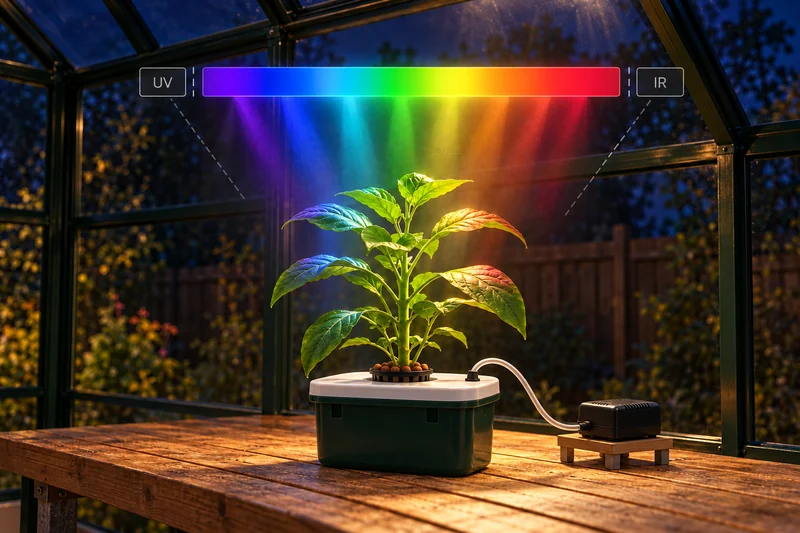
Image: RBHMMX · CC BY 4.0.
In brief
- Ordinary white light can work well for a small growing set-up.
- Shine the light on the plants, keep the lighting schedule regular and watch how they grow.
- Plants use more colours than blue and red. Purple light is not essential.
- Start simply. You don’t need an expensive meter to grow a few plants at home.
Start with the plant and the space
Are you planning to start a few seeds, keep basil in the kitchen, or harvest tomatoes all winter? These are different projects. A small plant on a shelf is easier to manage than a large tomato plant with leaves at every level. Lettuce and many herbs also get by with less light than plants expected to produce a lot of fruit.
First decide where the plants will go and how large an area needs lighting. Make use of daylight when it is available, but remember that light levels fall quickly as you move away from a window. Shade from neighbouring buildings, the direction the window faces and the time of year all matter.
Which light is suitable?
Almost any common light source can be used to grow a plant. A fluorescent tube from a DIY shop or an ordinary white LED bulb from IKEA does not need to be labelled ‘grow light’ to be useful. A small decorative bulb still won’t light an entire tomato plant. You need enough light in the right place.
If you’re buying a new light, LED is usually a convenient option. LED lights can be compact, lightweight and energy-efficient. A fluorescent tube or light bar spreads the light along a whole plant shelf, while a bulb in a suitable lamp may work for one or a few pots. Fluorescent tubes that you already have can also be put to good use. HPS and MH lamps can give off a lot of light, but need more attention to heat and equipment. Incandescent bulbs and halogen lamps, on the other hand, use unnecessarily large amounts of electricity and produce a lot of heat for the visible light they provide.
Do you get more for your money with a more expensive grow light?
Perhaps, but the price tag won’t tell you. A light that costs eight times as much does not automatically provide eight times more light to the plant, let alone produce eight times the harvest. A good grow light may deliver more light to the growing area, use electricity more efficiently, or offer convenient hanging and dimming options. For a few seedlings, ordinary white light may still be quite enough.
Compare the complete set-up: the light, lamp or arm, fittings and electrical connection. A cheap fluorescent tube without an arm is not the same package as a ready-to-use lamp. The question is what you get for your money over the area you intend to grow in.
Wavelength and colour
The colour of light is related to its wavelength. Blue light has a shorter wavelength than red, while white light is a mixture of many wavelengths. Plants respond differently to different colours, both in photosynthesis and in the way they grow.
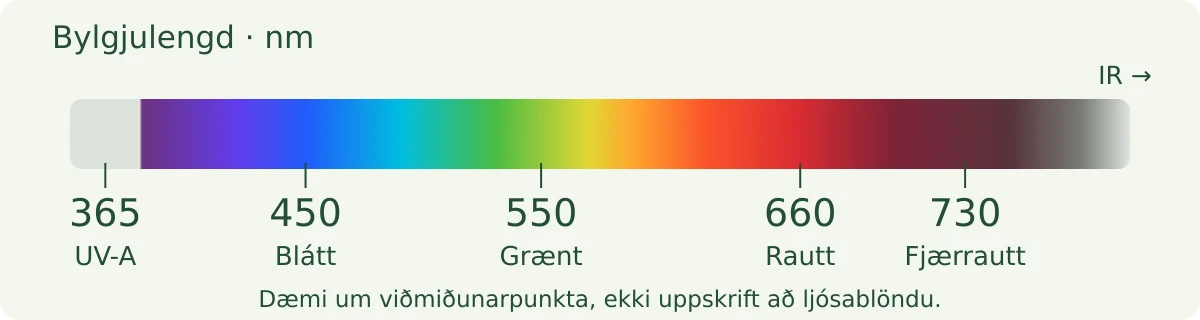
Image: RBHMMX · CC BY 4.0.
You may have heard that plants need only blue and red light. That’s a myth. These colours are useful, but green light is useful too and can reach into dense foliage. Green leaves don’t mean the plant rejects all green light. Ordinary white light contains blue and red as well as other colours, and it also makes it easier to see how the plant is doing than purple light does.
On white bulbs you’ll often see a number such as 2700 K, 4000 K or 6500 K. It describes whether the light appears warm and yellowish or cooler and bluer. This is colour temperature, not the heat from the bulb or a rating of its suitability for growing. White lights with different colour temperatures can all be useful; having enough light matters more than finding one magic number.
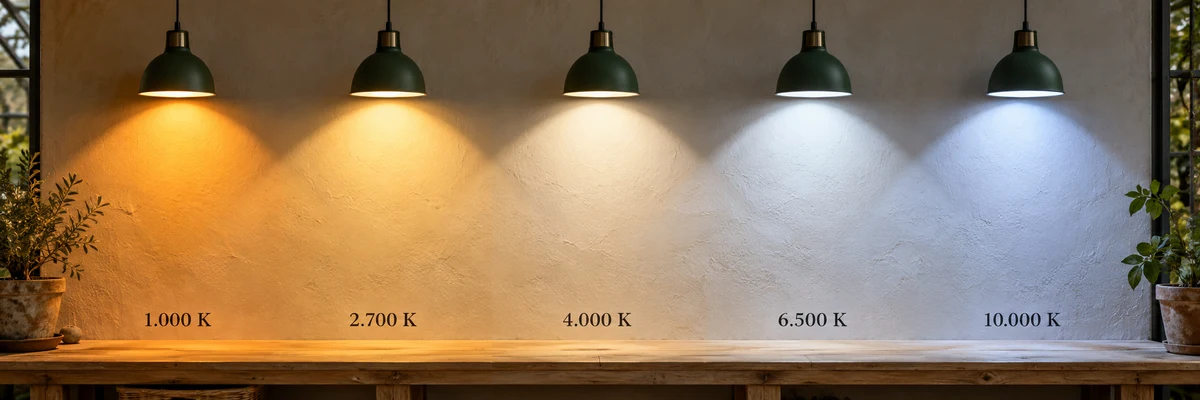
Image: RBHMMX · CC BY 4.0.
UV and infrared light are outside the range we can see. They can affect plants, but you don’t need to add a special UV lamp to start growing at home. Don’t choose equipment just because the box lists more abbreviations.
For the light nerds: what does research say about colour?
Plants use light both as an energy source and as information about their surroundings. Colour can therefore affect photosynthesis, a plant’s shape and the colour of its leaves. The numbers below refer to the corresponding points marked in the illustration. They are reference points within broader ranges, not five magic numbers you need to buy a lamp for.
Blue, for example 450 nm
Blue light is useful in photosynthesis and can have a strong effect on a plant’s form. In a 2021 lettuce experiment, a higher proportion of blue light produced smaller leaves and more of certain pigments, but also less growth under those conditions. A compact plant and the greatest possible harvest are not necessarily the same outcome. Responses depend on the species and the light mix.
Green, for example 550 nm
Green light penetrates somewhat deeper into a leaf than blue or red. It can therefore reach cells that receive less of the other colours. Measurements of lettuce leaves found that green light was used effectively at high light intensity, although red light had the advantage at low intensity. So the idea that green light is simply wasted does not hold up.
Red, for example 660 nm
Red light can drive photosynthesis very effectively, but it is not a special ‘flowering colour’ that alone takes care of flowers and fruit. A plant responds to the interaction of colours, lighting duration and other conditions. It is too simplistic to say blue for leaves and red for flowers.
Far-red, for example 730 nm
Far-red light lies just beyond the conventional 400–700 nm range often used in photosynthesis measurements. Research shows that light around 700–750 nm can contribute to photosynthesis in combination with shorter wavelengths. It can also change a plant’s form, including by increasing leaf size and stem elongation. In some lettuce experiments, growth increased when far-red was part of the light mix, but the effects were not always the same. You can’t take one such result and promise the same benefit in every window.
UV-A, for example 365 nm
In experiments, UV-A has, among other things, increased certain pigments and defence compounds in lettuce. One study also found stress in the plants at the highest dose. More was therefore not automatically better. UV light requires special care to protect the eyes and skin; this is not a recommendation to add a UV lamp to your home-growing set-up.
What do we do with all this, then? First, make sure there is enough light, that it is well distributed and that the lighting period is suitable. Then you can nerd out about colours if you’re interested. An experiment on one lettuce cultivar does not tell us exactly what the tomato plant at your home wants, and good white light may still be the simplest solution.
What do the numbers on the box mean?
Watts (W) tell you how much electrical power the light uses. Check the actual power consumption, not just a large number saying that the bulb is ‘equivalent to 60 W’. Two bulbs using the same number of watts can give off different amounts of light.
Lumens (lm) describe luminous flux as our eyes perceive it. They are useful for a rough comparison between similar white lights. More lumens per watt then indicate better efficiency, but don’t tell you how much of the light reaches the plant. Don’t use lumens alone to compare a white bulb with a red-and-blue grow light.
Lux describes the light falling on a particular surface. A phone with a light-meter app can give you a rough idea of the difference between the middle of the shelf and its edge, or what happens when you move the lamp closer. Hold the phone the same way each time and measure at leaf height. This is a comparison aid; accuracy varies greatly between phones and apps.
And what are PPFD and DLI?
These are measurements you sometimes see with grow lights. PPFD describes how much light in a particular photosynthetic range reaches the plants at any given moment, while DLI adds it up over the day. You don’t need to buy a meter or learn these abbreviations to get started.
How long should it stay on?
A simple timer saves you having to remember this every day. For many seedlings, you can start with around 14–16 hours of light per 24-hour period and switch it off overnight. The need depends on the species, stage of growth and any daylight the plants receive. Leaving a dim bulb on around the clock won’t necessarily solve a lack of light.
Distance makes the hills look blue
… but it can make a grow light ineffective. A lamp that lights the room nicely may be much too far from the plant to help it much. The farther the light spreads, the larger the area it covers and the less reaches each leaf.
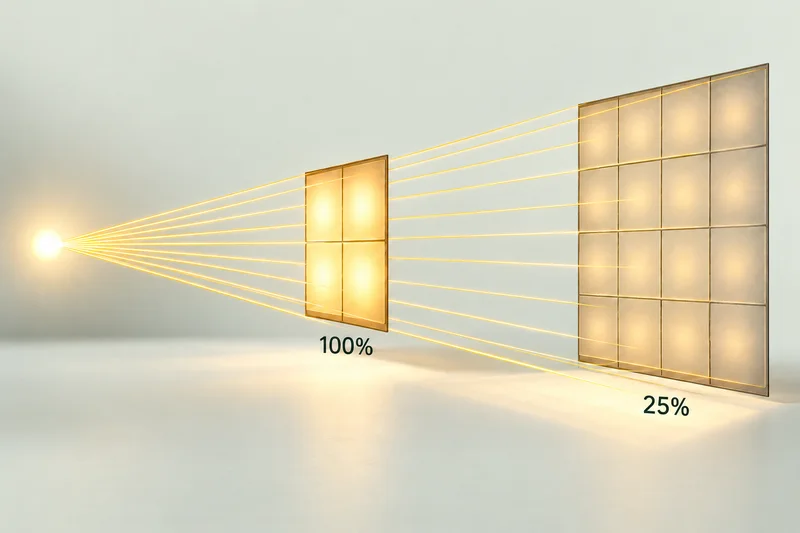
Image: RBHMMX · CC BY 4.0.
This inverse-square rule applies to a simple point source. A long fluorescent tube or a large LED panel, especially close to the plant, does not behave in exactly the same way. There is therefore no single distance in centimetres that suits every lamp. Start with the light manufacturer’s recommendations if available, make sure the light reaches across the plants, and adjust the lamp as needed. Too close can give intense light in the middle while leaving the edges in shade.
Watch the new growth. Long, weak stems can indicate too little light. Pale or scorched upper leaves can point to too much light or heat, although the same symptoms can have other causes. Change one thing at a time so you can see what helps.
All electric lighting warms the room, including LEDs. Leave a gap between the leaves and the light, secure the lamp properly, and keep electrical equipment away from watering and splashes. An ordinary indoor light does not become waterproof just because it is above a plant tray.
See also
Originally published: 21 February 2023. Last substantively reviewed: 9 October 2026.
Translated from Icelandic with AI assistance. Read the Icelandic original. Links to untranslated articles open in Icelandic.